
Maca root shows up as a fine tan powder in most shops, but the plant actually grows in a range of colors — and the powder is sold in two different processing styles, raw and gelatinized. If you are trying to choose between yellow, red, and black maca, or wondering what "gelatinized" means, this guide breaks down what genuinely differs and what is mostly marketing, with sources.
What is maca?
Maca is Lepidium meyenii, a cruciferous root vegetable in the family Brassicaceae — the same family as broccoli, cabbage, and radish.1 It is cultivated high in the Peruvian Andes, at altitudes around 4,000 meters, making it one of the few food crops that thrives in that harsh, windswept, high-altitude environment.1 The root is harvested, dried, and ground into powder. Andean peoples have grown and eaten maca as a food for centuries.1
The three maca colors
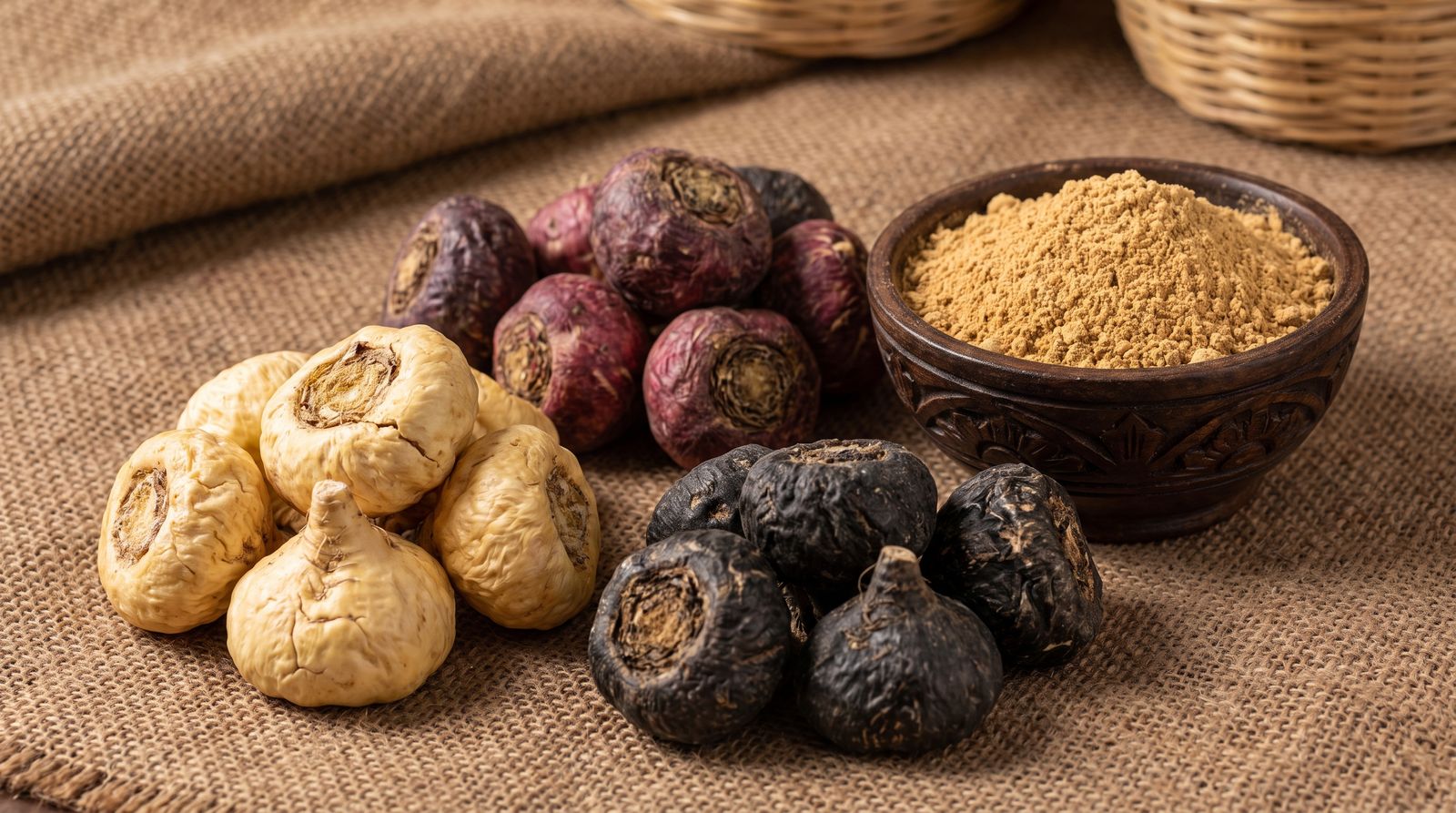
Maca roots grow in a spectrum of colors, but they are commonly grouped and sold as three: yellow, red, and black. Importantly, these are not different species — they are color variants ("phenotypes") of the same plant, Lepidium meyenii.2 The color reflects natural variation in the crop:
- Yellow maca — by far the most common variety, making up the majority of the harvest. It is the everyday, widely available maca.
- Red maca — a less common color variant, prized for its milder, slightly sweeter flavor.
- Black maca — the rarest of the three, with a more distinctive, earthier taste.
Researchers note that the different color varieties can differ somewhat in their nutritional and phytochemical profiles, which is why the colors are studied and sold separately rather than blended by default.2 That said, all three are the same root vegetable and are used the same ways in the kitchen.
Red vs. black vs. yellow: how to choose
| Color | Rarity | Flavor | Good pick if… |
|---|---|---|---|
| Yellow | Most common | Classic, malty, earthy | You want the standard, versatile maca to start with. |
| Red | Less common | Milder, slightly sweeter | You prefer a gentler taste that blends easily into smoothies. |
| Black | Rarest | Stronger, earthier, nuttier | You want the most distinctive-tasting variety. |
If you are new to maca, yellow is the sensible starting point — it is the most available and the most neutral in flavor. From there, many people try red or black to find the taste they like best.
Gelatinized vs. raw maca: what's the difference?
Beyond color, you will see maca sold as either "raw" or "gelatinized." This has nothing to do with gelatin (it is entirely plant-based) — it refers to processing:
- Raw maca is the root simply dried at low temperature and milled. It keeps the powder closest to the whole food, but it still contains the root's natural starch.
- Gelatinized maca has been gently heated (often with pressure) to remove much of that starch. "Gelatinization" here is the food-science term for breaking down starch granules with heat and moisture.3 The result is a more concentrated powder that many people find easier to digest and quicker to dissolve.
Neither is inherently "better" — raw is closer to the whole root, while gelatinized trades a bit of processing for easier digestion and mixing. People who find raw maca hard on the stomach often prefer the gelatinized form.
A note on traditional use
Maca has a long history as an Andean food crop and has traditionally been valued for supporting energy and stamina at high altitude.1 It is worth being clear-eyed here: maca is a food, not a medicine, and while it has been studied, we are not making health claims about it. If you are considering it for a specific health reason, that is a conversation for a qualified healthcare provider.
How to use and store maca
Maca powder is a kitchen ingredient. People most commonly stir it into smoothies, oatmeal, coffee, or baked goods — a little goes a long way because the flavor is assertive. Store the powder in an airtight container away from heat, light, and humidity, and it will keep its flavor for a long time.
The short version
Yellow, red, and black maca are color variants of the same Peruvian root, Lepidium meyenii — yellow is the everyday standard, red is milder, and black is the rarest and most distinctive. Separately, "gelatinized" maca has had its starch reduced by gentle heat for easier digestion, while "raw" stays closest to the whole root.
Ready to try it? Compare our yellow, red, and black maca — ground Andean root, shipped within 24 hours from Portland, Oregon.
Sources
- "Lepidium meyenii" (maca; Brassicaceae; Peruvian Andes; food crop, altitude, traditional use). Wikipedia. en.wikipedia.org/wiki/Lepidium_meyenii
- Gonzales GF. "Ethnobiology and Ethnopharmacology of Lepidium meyenii (Maca)." Evid Based Complement Alternat Med, 2012 (PMC3184420) — color phenotypes and their differing profiles. pmc.ncbi.nlm.nih.gov/articles/PMC3184420
- "Starch gelatinization" (the food-science process of breaking down starch with heat and moisture). Wikipedia. en.wikipedia.org/wiki/Starch_gelatinization