
Buy Frankincense Online
Third-Party Lab Tested
Independent lab COA available on request
about this product
What is Frankincense?
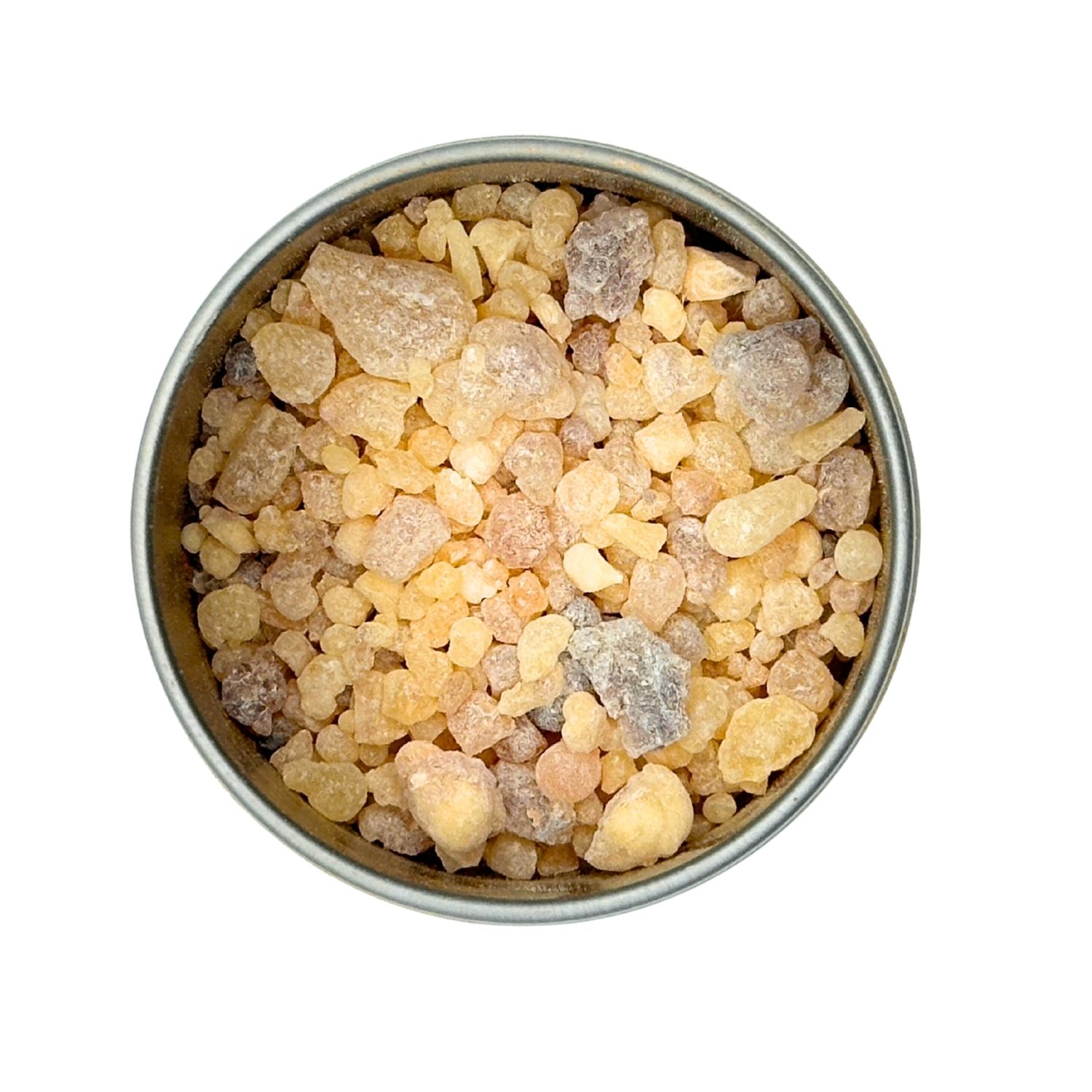
Frankincense is the hardened resin of trees in the Boswellia genus (family Burseraceae), primarily Boswellia sacra and the closely related Boswellia carterii. It ships as "tears," the droplets of resin collected from tapped trees. This is a resin rather than a dried leaf or root, which is why it is prepared and used differently from most botanicals.
About the resin
The Boswellia trees grow in the arid mountains of southern Arabia and the East African Horn. Growers make small incisions in the bark, and the milky sap that seeps out hardens into tears of resin, which are then collected. Frankincense was one of the most valuable commodities of the ancient world, carried north along the Incense Route across the Levant for over a thousand years and valued in Egyptian, Greek, Roman, and Hebrew practice. The English name comes from the Old French "franc encens," meaning high-quality incense. The aroma is warm and balsamic with citrus and pine notes, and it varies by Boswellia species and origin. The primary compound class is the boswellic acids.
How Frankincense is burned
The traditional method uses incense charcoal. A piece of charcoal is lit until it glows and ashes over, then set in a heatproof bowl on a bed of sand, and a single tear of resin is placed on top. The resin melts and releases fragrant white smoke for several minutes. Frankincense is also distilled into an essential oil and included in many traditional incense blends.
Frankincense: form & sizes
We carry organic Frankincense as whole resin tears, sold by weight in sizes from 1 oz to 1 lb. We make no health or therapeutic claims.
Storage
Store the resin in an airtight container, away from heat, light, and humidity, to preserve its aroma.
Frankincense at a glance
- Botanical name
- Boswellia sacra and related species
- Family
- Burseraceae
- Native region
- the Arabian Peninsula and East Africa
- Form
- Hardened resin tears
- Sourcing
- Organic
- Sizes
- 1 oz to 1 lb
Frequently asked questions
What does Frankincense smell like?
How do I burn Frankincense?
Why was Frankincense so valuable historically?
What sizes does Frankincense come in?
Do you ship Frankincense to my state?
Buy Frankincense Online
Select a size
Orders ship within 24 hours of being placed.
Secure encrypted checkout
What customers say about our shop
4.8 stars across 284 Google reviewsGood herb selection; reasonable prices. Lots of loose herbs, tinctures, smudge/incense, pipes. By herbs I mean various medicinal and alchemical herbs - I bought some lemon balm, organic roses, and lemongrass as well and bundles white sage and white pine. Good source for alternative/complimentary smoking herbs as well…
Herb Stomp (Sandy) is BY FAR the best Herb and Kratom store I have ever been to. In my 2.5 years of using Kratom, I have never been to a place as helpful as this! The employees are so so helpful! Usually when buying Kratom, I’m met with grumpy head shop owners who seem to want me to either spend out of my budget, or…
Awesome, knowledgeable staff. Great selection and quality of herbs and ethnobotanicals. I also appreciate that testing is done for contaminants and potency on certain herbs. In 8 years coming here I have yet to purchase anything stale or otherwise questionable quality. We technically *could* ask for more in a local…
also in herbs & spices