Buy Himalayan Pink Salt Online
Third-Party Lab Tested
Independent lab COA available on request
about this product
What is Himalayan Pink Salt?
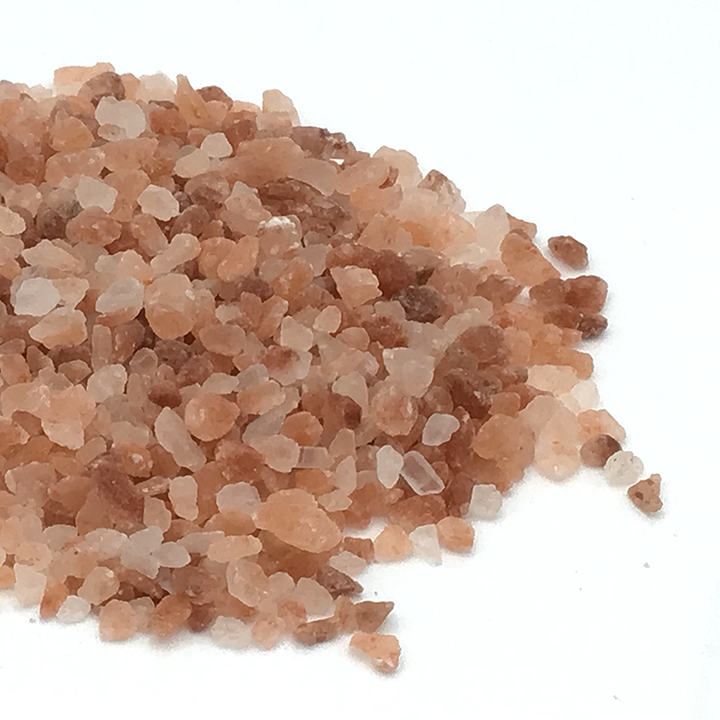
Himalayan Pink Salt is a pink, mineral-rich rock salt (halite) mined from ancient sea-bed deposits in the Punjab region of Pakistan. Its characteristic pink tint comes from trace iron oxide in the crystal.
About the salt
The salt formed roughly 250 million years ago, when prehistoric seas evaporated and later geological activity pushed the deposits upward alongside the rise of the Himalayan range. Most of it is mined at the Khewra Salt Mine, one of the largest salt mines in the world. Despite the "Himalayan" name, the salt is quarried in Pakistan's Punjab, in the foothills of the range. Like other rock salts it is about 97 to 98 percent sodium chloride; the trace minerals that tint it give it its color rather than a markedly different composition.
Uses
Himalayan pink salt is used like any culinary salt, with a fine grind for everyday cooking and a coarse grind for finishing. Larger carved slabs are used as salt cooking blocks, and carved blocks fitted with a light are sold as salt lamps.
Himalayan Pink Salt: form & sizes
We carry Himalayan Pink Salt sold by weight in sizes from 1 oz to 1 lb. We make no health or therapeutic claims.
Storage
Store the salt in an airtight container, away from humidity, to keep it dry and free of clumping.
Himalayan Pink Salt at a glance
- Type
- Rock salt (halite)
- Origin
- Khewra Salt Mine, Punjab, Pakistan
- Color source
- Trace iron oxide
- Composition
- Roughly 97 to 98 percent sodium chloride
- Age
- Formed about 250 million years ago
- Sizes
- 1 oz to 1 lb
Frequently asked questions
Where does Himalayan pink salt actually come from?
Why is it pink?
Can I use it like regular salt?
What is a salt block?
Do you ship to my state?
Buy Himalayan Pink Salt Online
Select a size
Orders ship within 24 hours of being placed.
Secure encrypted checkout
What customers say about our shop
4.8 stars across 284 Google reviewsGood herb selection; reasonable prices. Lots of loose herbs, tinctures, smudge/incense, pipes. By herbs I mean various medicinal and alchemical herbs - I bought some lemon balm, organic roses, and lemongrass as well and bundles white sage and white pine. Good source for alternative/complimentary smoking herbs as well…
Herb Stomp (Sandy) is BY FAR the best Herb and Kratom store I have ever been to. In my 2.5 years of using Kratom, I have never been to a place as helpful as this! The employees are so so helpful! Usually when buying Kratom, I’m met with grumpy head shop owners who seem to want me to either spend out of my budget, or…
Awesome, knowledgeable staff. Great selection and quality of herbs and ethnobotanicals. I also appreciate that testing is done for contaminants and potency on certain herbs. In 8 years coming here I have yet to purchase anything stale or otherwise questionable quality. We technically *could* ask for more in a local…
also in herbs & spices