
Palo santo is the fragrant wood of Bursera graveolens, a tree of the dry tropical forests of Ecuador, Peru, and their neighbors, burned as incense for its sweet, citrusy smoke. The name is Spanish for "holy wood." This guide covers what palo santo is, how to burn it, and the question we hear most at the counter: is palo santo endangered? The honest answer has two parts, and most pages only give you one.
What is palo santo?
Palo santo is Bursera graveolens, a small to medium tree in the family Burseraceae. That family also produces frankincense (Boswellia) and myrrh (Commiphora), which helps explain the resinous smell.1 Its native range runs from Mexico through Central America to northwestern Venezuela, Colombia, Ecuador (including the Galápagos), and Peru, mostly in seasonally dry tropical forest.1
In the dry season the tree drops its leaves and stands as a bare, pale-barked frame, which is how many visitors to coastal Ecuador and northern Peru first see it. The wood is light in color and, in the pieces that are prized for incense, noticeably oily.
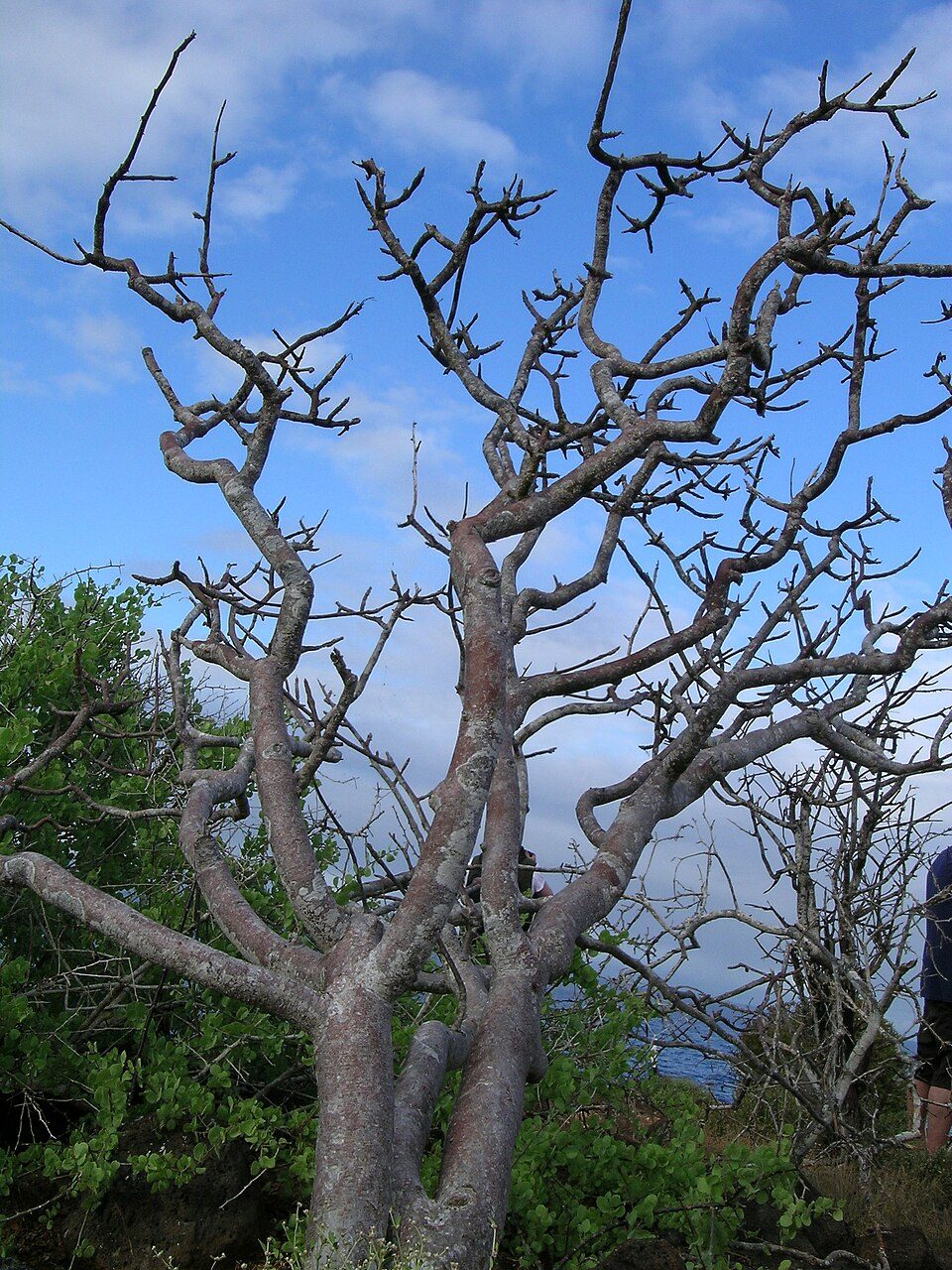
Two different trees are both called palo santo
This is where most of the confusion about palo santo starts. "Palo santo" is a common name, and at least two unrelated trees carry it:
| Bursera graveolens | Bulnesia sarmientoi | |
|---|---|---|
| What it is sold as | Palo santo incense sticks | Timber and "guaiac wood" oil |
| Where it grows | Mexico to Peru, dry tropical forest | Gran Chaco of Argentina, Bolivia, Paraguay, and Brazil |
| IUCN Red List | Least Concern, population stable (2019)2 | Endangered, population decreasing (2018)3 |
| CITES | Not listed4 | Appendix II since 20105 |
The sticks you light at home, ours included, are Bursera graveolens. When you read that "palo santo is endangered and on CITES," the writer is usually describing the Chaco tree, Bulnesia sarmientoi, which is harvested for heavy timber and essential oil and has been regulated in international trade since 2010.5
Is palo santo endangered?
Globally, no. The IUCN Red List assessed Bursera graveolens in 2019 and rated it Least Concern with a stable population, largely because it grows across a wide range of countries.2 It is not on any CITES appendix.4
In Peru, yes. Peru's national list of threatened flora, Decreto Supremo 043-2006-AG, classifies Bursera graveolens as critically endangered (CR) within Peru, and the decree bans extracting, transporting, or exporting listed species outside approved management plans.6 Peru's forestry agency, SERFOR, says those plans forbid cutting standing live trees and allow only branches, debris, and trees that died naturally.7
That protection is actively enforced. In January 2026, SERFOR seized more than 1,300 kilograms of illegally sourced palo santo logs in the Piura region and repeated that only naturally fallen or dead material may be collected.8
So the practical answer is this: the species is not at risk of extinction worldwide, but illegal cutting of live trees is a real problem in at least one of the main producing countries. Where your palo santo comes from, and how it was collected, matters.
Why do some people say to stop using palo santo?
The arguments usually come from three places:
- Overharvesting. Demand has grown fast, and Peru's seizures show that live trees do get cut illegally. This concern is legitimate.
- The two-tree mix-up. Warnings about an endangered, CITES-listed palo santo are often accurate for Bulnesia sarmientoi and get applied to Bursera graveolens by mistake.
- Cultural context. Palo santo has ceremonial meaning in Indigenous and mestizo traditions in Ecuador and Peru, and some people prefer not to use it casually.
If you choose to use it, the most useful thing you can do is buy from a seller who names the species and sells naturally fallen wood. Our palo santo is Bursera graveolens, and our suppliers collect naturally fallen wood only. And because a stick can be relit many times, a single one goes a long way.
What does palo santo smell like?
Sweet, woody, and bright, with a citrus top note and a faint cool, minty edge. The chemistry backs up the citrus. A 2021 study of Bursera graveolens essential oil found it was 77.6% D-limonene, the same compound that gives orange peel its scent.9 An earlier analysis of oil from Ecuadorian palo santo found limonene at 58.6% alongside 10.9% α-terpineol, a compound with a soft, lilac-like, piney note.13
You will often read that the aroma "only develops" after a tree dies and the wood ages on the forest floor for years. We looked for research on that and could not find a published study comparing live and aged wood. It is a widely repeated trade belief, and aged, oily heartwood is certainly what the trade prizes, but the stronger reason to buy fallen wood is the legal and ecological one above.
What is palo santo used for?
- Incense and aroma. By far the most common use today: burning a stick for its smoke and scent, at home, in yoga and meditation spaces, or alongside other smudge herbs.
- Ceremony. Palo santo is burned in traditional and ritual settings in Ecuador and Peru, and has become a staple of the incense and smudging trade far beyond them.10
- Keeping insects away. In the dry valleys of Piura, the smoke was historically used to keep mosquitoes off. A 2025 laboratory study found palo santo oil repelled Aedes albopictus mosquitoes for more than 45 minutes, which lines up with the folk use.11, 12 That is a lab result, not a guarantee, so do not rely on it where mosquito-borne disease is a concern.
We sell palo santo as incense and make no health or therapeutic claims for it.
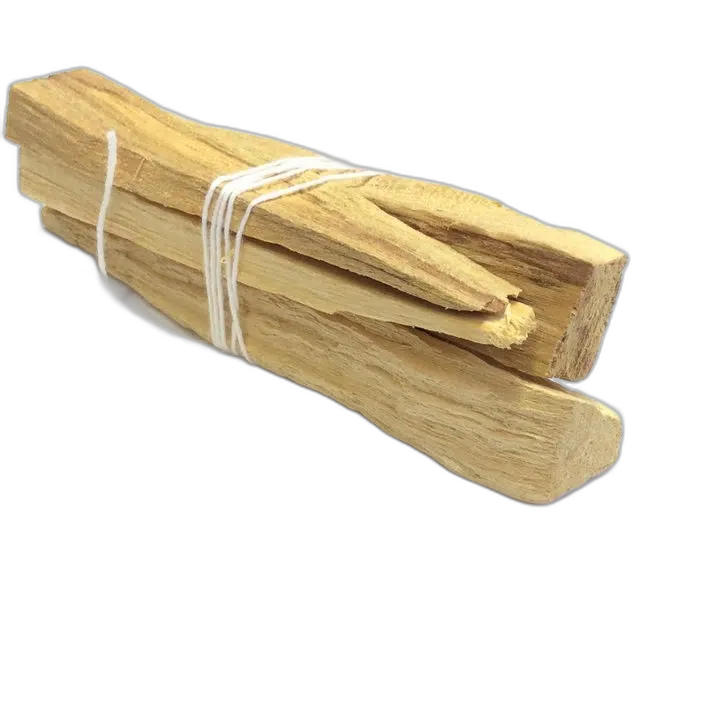
How to burn palo santo
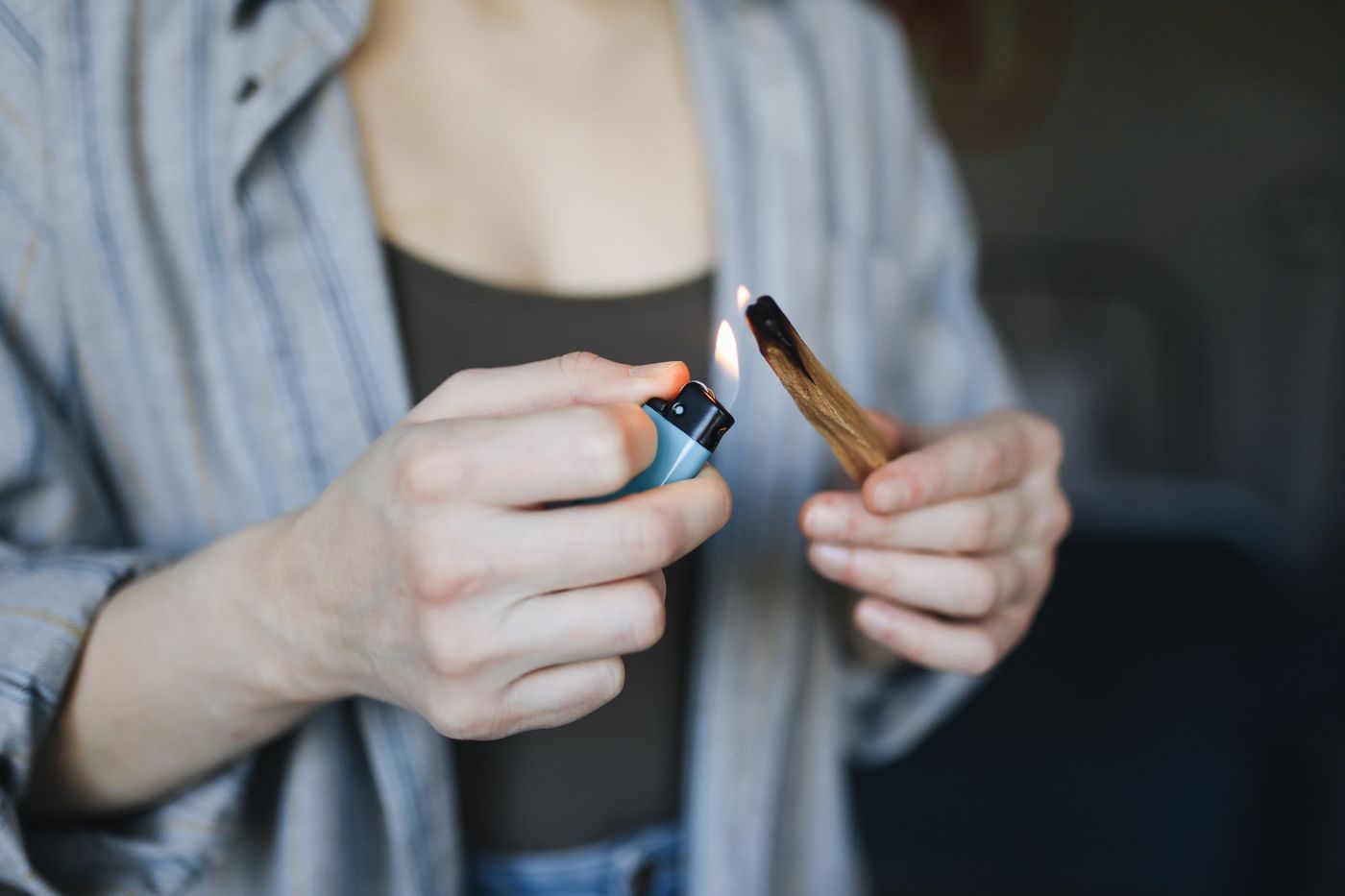
- Light one end. Hold a match or lighter to the tip of the stick at an angle, pointing downward, for 30 seconds to a minute until it catches.
- Let it flame briefly, then blow it out. You want a glowing ember that smokes, not an open flame.
- Let it smolder over a heatproof dish. A ceramic or metal dish with a layer of sand works well. The stick usually goes out on its own after a few minutes.
- Relight as needed. One stick lasts through many sessions. If it won't stay lit, it may help to light a fresh edge or a thinner corner.
- Put it out safely. Press the tip into sand or the dish until the smoke stops. Never leave it burning unattended.
Burn it in a ventilated room, keep it away from curtains and pets, and skip it around anyone with asthma or smoke sensitivity. Any smoke you breathe indoors is still smoke.
How to store palo santo
Keep the sticks dry, at room temperature, and in a closed container or drawer when you are not using them. The aromatic oils fade slowly with air and sunlight, so a stick left on a sunny windowsill will lose its scent sooner than one kept in a box.
The short version
Palo santo is the aromatic wood of Bursera graveolens, a relative of frankincense and myrrh from the dry forests of Ecuador, Peru, and their neighbors. It is rated Least Concern worldwide and is not on CITES, but Peru lists it as critically endangered and allows only naturally fallen or dead wood to be collected. The endangered, CITES-listed "palo santo" is a different tree, Bulnesia sarmientoi. Buy from a seller who names the species and the harvest method, and a single stick will last a long time.
Shop palo santo sticks, or browse our full smudge and incense shelf, including white sage smudge and sweetgrass braids. Orders ship within 24 hours from our shop in Portland, Oregon.
Sources
- "Bursera graveolens (Kunth) Triana & Planch." Plants of the World Online, Royal Botanic Gardens, Kew. powo.science.kew.org
- Fuentes, A., Martínez Salas, E. & Samain, M.-S. 2019. "Bursera graveolens." The IUCN Red List of Threatened Species, e.T67836767A144249196. iucnredlist.org
- "Plectrocarpa sarmientoi" (syn. Bulnesia sarmientoi). The IUCN Red List of Threatened Species, assessed 2017, published 2018. iucnredlist.org
- Species+ / CITES Checklist search for Bursera (no listed taxa). UNEP-WCMC and CITES Secretariat. speciesplus.net
- "Bulnesia sarmientoi," legal status (Appendix III 2008, Appendix II from 23 June 2010). Species+. speciesplus.net. See also CITES CoP15 Proposal 42. cites.org (PDF)
- Decreto Supremo Nº 043-2006-AG, "Aprueban categorización de especies amenazadas de flora silvestre," Annex 1 (Bursera graveolens, En Peligro Crítico). El Peruano, 13 July 2006. sinia.minam.gob.pe (PDF)
- SERFOR. "SERFOR y Aduanas decomisan palo santo ilegal en empresa de transporte de carga en Piura," 22 January 2021. gob.pe
- "Piura: Serfor incauta más de una tonelada de madera de palo santo de origen ilegal." Andina (Peruvian state news agency), January 2026. andina.pe
- Noel-Martinez, et al. 2021. "Bursera graveolens essential oil: physicochemical characterization and antimicrobial activity in pathogenic microorganisms found in Kajikia audax." Scientia Agropecuaria 12(3). doi.org/10.17268/sci.agropecu.2021.033
- Pombo Geertsma, I., Zandstra, B.E., Stefanaki, A. et al. 2024. "Commercialized 'smudge sticks' used as incense in the Netherlands: an inventory of plants and trends behind a New Age fashion." Plants. PMC11547997
- Parichanon, P., Ascrizzi, R., Tani, C. et al. 2025. "Chemical profiling, sensory qualities, and bioactivities of essential oils obtained from Aloysia citrodora and Bursera graveolens Ecuadorian plants against the mosquito Aedes albopictus." Insects 16(2):202. PMC11857052
- "Palo Santo." Camino Verde (Peruvian reforestation nonprofit). caminoverde.org
- Young, D.G., Chao, S., Casablanca, H. et al. 2007. "Essential oil of Bursera graveolens (Kunth) Triana et Planch from Ecuador." Journal of Essential Oil Research 19(6). doi.org/10.1080/10412905.2007.9699322
Header photo by Polina Tankilevitch on Pexels.