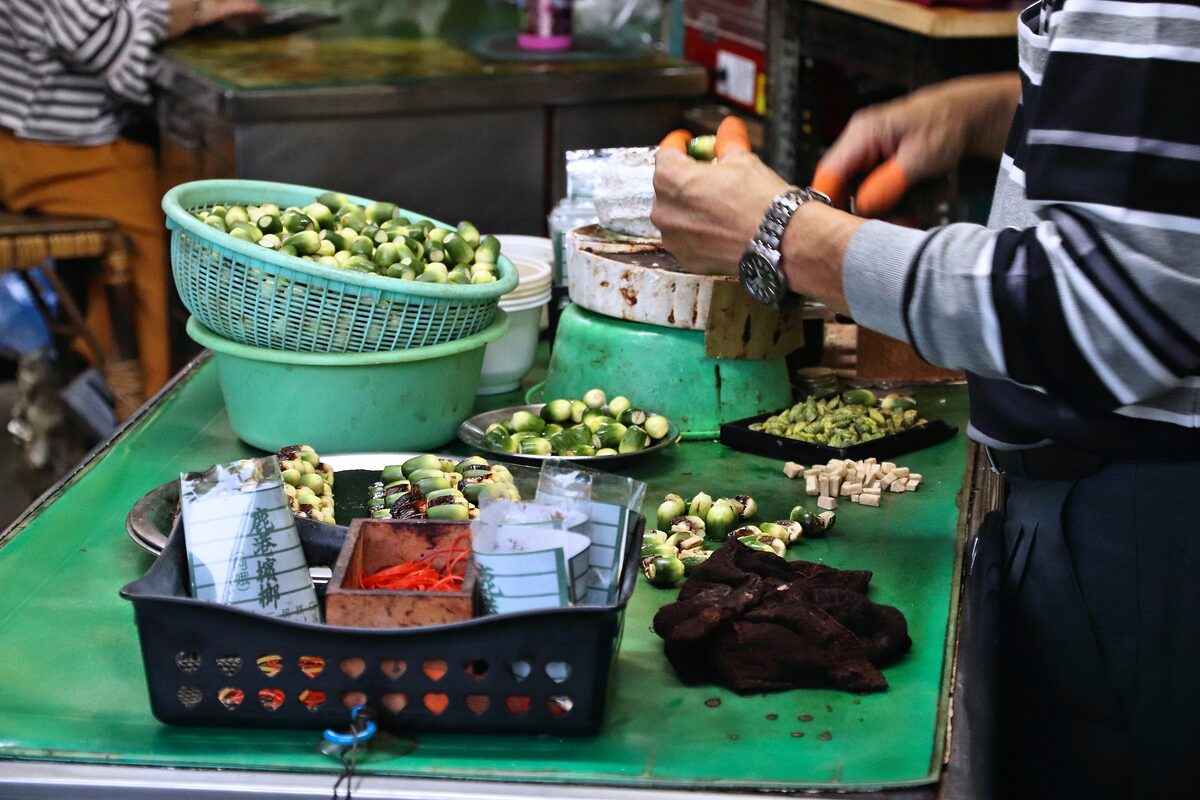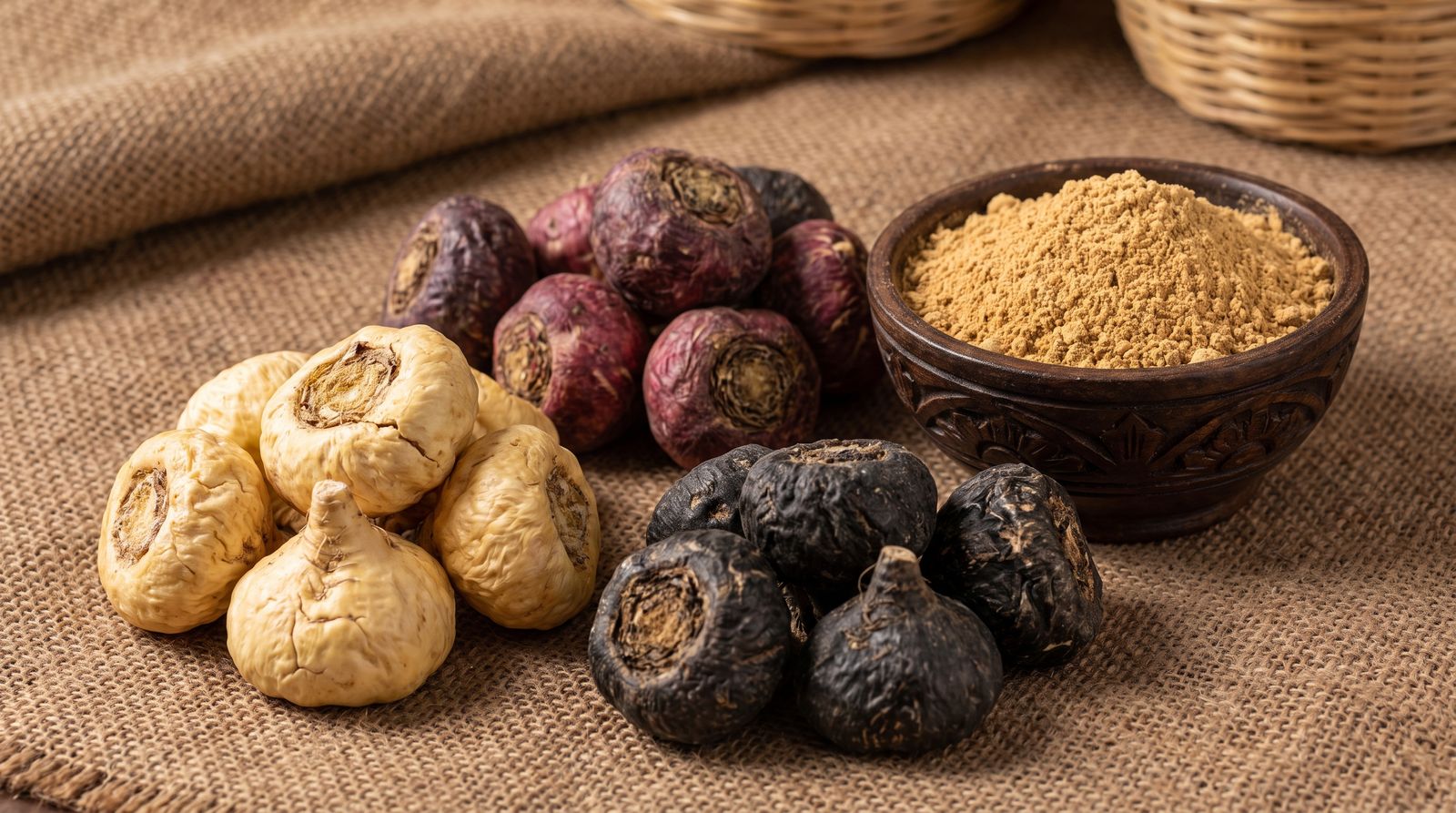

If you searched betel nut or areca nut, you probably found two very different kinds of pages: travel writing about red-stained smiles in Taipei and Yangon, and cancer research. Both are describing the same seed. This guide covers what the plant actually is, why it carries several names, the cultural record behind it, and the health evidence, which is unusually clear and which we are not going to bury at the bottom of the page. It is informational only, not health or usage advice.
What is betel nut, exactly?
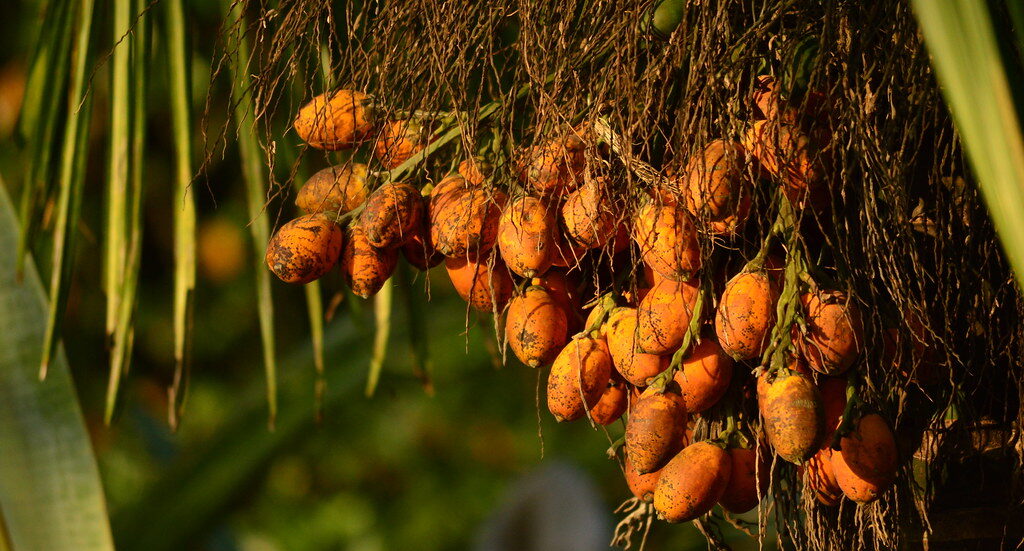
Betel nut is the seed of Areca catechu, a slender tropical palm in the family Arecaceae that grows across South and Southeast Asia, the Pacific Islands, and parts of East Africa.1 Botanically it is not a nut at all. The tree produces a fruit called a drupe, roughly the size and shape of a small egg, and the hard seed inside that fruit is what gets harvested, dried, and traded as "betel nut."
Cut one open and the cross-section is distinctive: a marbled tan-and-brown pattern that looks a little like nutmeg. That marbling is why carved and painted areca nuts show up as a folk-art medium in parts of India.
The seed's best-known constituent is arecoline, an alkaloid, along with several related compounds and a high tannin content that gives the raw seed its mouth-puckering astringency.2
Betel nut vs. areca nut: is there a difference?
No. Betel nut and areca nut are the same thing, and the botanical literature increasingly prefers "areca nut" precisely because "betel nut" is misleading.
The confusion comes from a second, entirely unrelated plant. Betel leaf is Piper betle, a climbing vine in the pepper family.1 Traditionally the areca seed is wrapped in a betel leaf before being chewed, and over time the leaf's name migrated onto the seed. So:
- Areca nut / betel nut is the seed of a palm, Areca catechu.
- Betel leaf is the leaf of a pepper vine, Piper betle.
- Betel quid (also called paan) is the prepared combination: areca nut, betel leaf, and slaked lime, sometimes with tobacco, spices, or sweeteners added.3
That distinction matters when you read the research, because studies are careful to separate areca nut on its own from betel quid with tobacco. They reach the same conclusion, as covered below, but they are not interchangeable terms.
What else is it called?
Few plants carry this many regional names, which is a decent proxy for how widely it travelled:
- Supari across much of India
- Pinang in Malay and Indonesian
- Binlang (檳榔) in Chinese, and the same character pair read as binrou in Japanese
- Pugua in Chamorro, on Guam and in the Northern Marianas
- Buai in Papua New Guinea and much of Melanesia
- Mak in Thai and Lao
Alongside those you will see the botanical name Areca catechu, and in older sources the Sanskrit puga and the Marathi pophali.
Where the areca palm grows
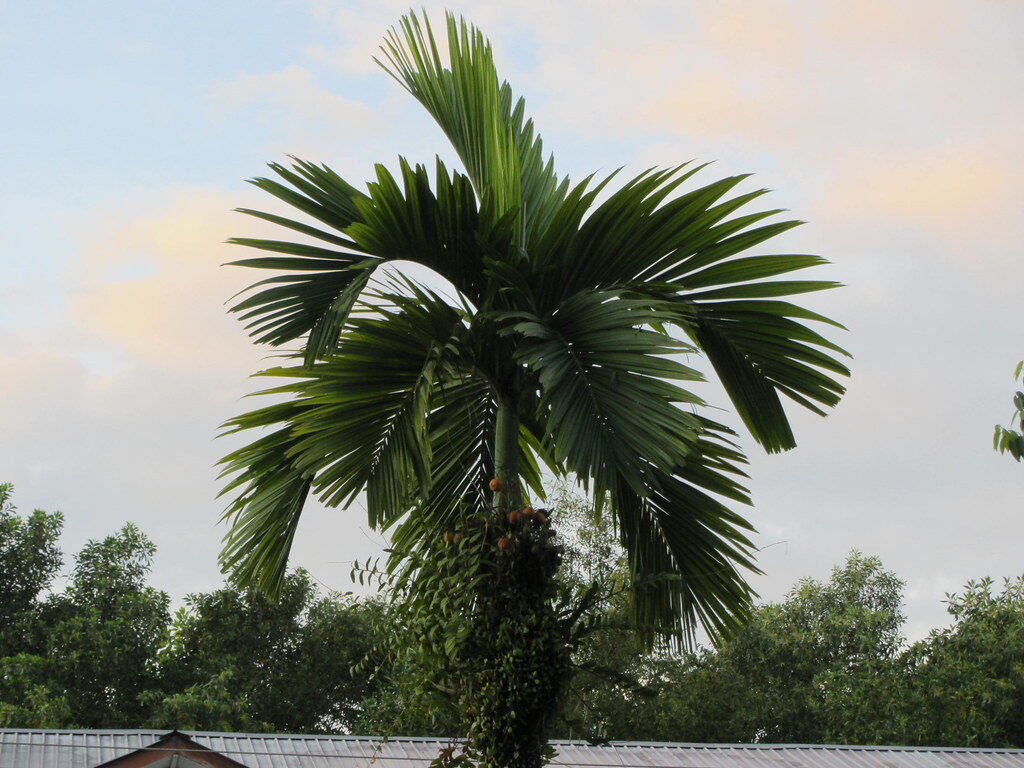
The areca palm is a tall, thin, single-trunked palm that can reach around 20 metres, with a crown of feathered fronds and no branching.1 It needs consistent warmth and humidity, so cultivation clusters in a wide band running from India and Sri Lanka through Bangladesh, Myanmar, Thailand, Malaysia, Indonesia, and the Philippines, out into Taiwan, Papua New Guinea, and the Pacific islands.
India is by a wide margin the largest producer. Harvesting is still often done by climbers who go up the trunk by hand and move between adjacent trees at the top, a skill that shows up regularly in documentary photography of the crop.
The cultural record
Areca nut has one of the longest documented histories of any traded plant material. Archaeological evidence for areca chewing in Southeast Asia goes back thousands of years, and the practice is woven into ritual and social life across an enormous geographic range.
In much of South Asia, betel quid is offered to guests and features in wedding and religious ceremonies. In parts of the Pacific, sharing areca is a basic gesture of welcome, and the associated toolkit, including the brass and iron cutters known as sarota in India, became a genuine decorative-arts tradition. Betel-related paraphernalia sits in museum collections worldwide: lime containers, spittoons, boxes, and cutters, often finely worked.
Estimates commonly cited by public-health bodies put current use somewhere in the hundreds of millions of people, which would make it one of the most widely used psychoactive substances on earth after caffeine, alcohol, and nicotine.3 That scale is exactly why the health research is as extensive as it is.
The health picture, stated plainly
This is the part of the topic that a lot of commercial pages skip, so here it is directly.
The International Agency for Research on Cancer, the WHO's cancer research body, evaluated betel quid and areca nut across working groups in 1984, 1987, 2003, and 2009. Its conclusion, published in IARC Monographs Volume 100E, is that betel quid without tobacco is carcinogenic to humans (Group 1) based on sufficient evidence of increased oral cancer risk, and that betel quid with tobacco is also Group 1, with sufficient evidence for cancers of the oral cavity, pharynx, and oesophagus.3 Group 1 is the agency's highest-certainty category, the same classification given to tobacco smoking and asbestos.
The evidence base also links long-term chewing to oral submucous fibrosis, a progressive stiffening of the tissues of the mouth. The US Food and Drug Administration, in its 2026 import alert on the material, cites the alkaloid arecoline as having reported cytotoxic, genotoxic, mutagenic, and carcinogenic effects.4
We think a shop selling a botanical should be able to tell you what the research says about it. We offer areca nut as a specimen for cultural, ceremonial, and ethnographic study, and we do not recommend chewing it.
How betel nut is sold
In the US you will generally encounter it in a few forms:
- Whole or split dried seed, the traditional trade form, sold by weight.
- Tincture, an alcohol-based liquid preparation in a dropper bottle.
- Powder, milled seed, more common in imported food products than in botanical supply.
Grading in producing countries is genuinely complex, turning on ripeness at harvest, whether the seed was boiled or sun-dried, and regional processing style. Most of that nuance does not survive the trip into the US specimen market, where the practical questions are simply whether the seed is whole and clean and whether the supplier is transparent about origin.
Is betel nut legal in the United States?
Broadly yes, with real caveats. Areca nut is not a controlled substance under federal law and is not scheduled by the DEA. But in March 2026 the FDA issued an import alert covering food products, dietary supplements, and bulk dietary ingredients that are or contain areca nut, which changes the picture for anything sold as food.4 Products containing tobacco are regulated separately as tobacco products, and Guam and the Northern Mariana Islands restrict sales to minors.
We cover all of that in detail in Is Betel Nut Legal in the US?, including what the import alert does and does not cover.
How to store it
Treat dried areca seed like any other dried botanical: sealed, cool, dry, and out of direct sunlight. The seed is dense and stores well, but humidity is the enemy, and a seed left in a damp cupboard will eventually mould. Keep the tincture capped and away from heat and light.
The short version
Betel nut and areca nut are two names for the seed of Areca catechu, a tropical palm. Betel leaf is a different plant, Piper betle, and betel quid is the prepared combination of the two plus slaked lime. The seed has a documented cultural history stretching back millennia across Asia and the Pacific, and it carries a Group 1 carcinogen classification from the WHO's cancer agency for that traditional chewing use. We stock it as a specimen for people studying that history, not as something to consume.
Browse whole betel nut and betel nut tincture, or see the full ethnobotanicals collection. Orders ship within 24 hours from our shop in Portland, Oregon.
Sources
- "Areca catechu" (areca palm; description, range, cultivation; Piper betle as the distinct betel leaf plant). Wikipedia. en.wikipedia.org/wiki/Areca_catechu
- "Arecoline" (principal alkaloid of areca nut). PubChem, National Library of Medicine. pubchem.ncbi.nlm.nih.gov
- IARC Monographs on the Evaluation of Carcinogenic Risks to Humans, Volume 100E: "Betel Quid and Areca Nut" (2012). Group 1 classification for betel quid with and without tobacco. ncbi.nlm.nih.gov/books/NBK304393
- FDA Import Alert 23-15, "Detention Without Physical Examination of Food Products Including Finished Dietary Supplements and Bulk Dietary Ingredients, That Are, or That Contain, Areca (Betel) Nuts…" published 2026-03-23. accessdata.fda.gov