Kratom is the leaf of Mitragyna speciosa, a tropical evergreen tree in the coffee family (Rubiaceae) that is native to Southeast Asia.12 What you see sold as kratom in the US is that leaf, dried and usually milled into a fine green powder. This guide covers the tree, what the leaf is made of, where it comes from, how it gets processed, and what to look for in a seller. It is botany and buying information, not usage advice: we sell kratom for external use only.
The tree: Mitragyna speciosa
The plant was first described by the Dutch colonial botanist Pieter Korthals in 1839, under the name Stephegyne speciosa. George Darby Haviland gave it the classification it carries today in 1859, which is why you will see the full botanical name written Mitragyna speciosa (Korth.) Havil.1
Its native range runs through Thailand, Malaysia, Indonesia, Myanmar and Papua New Guinea, and it is also indigenous to Cambodia.1 In Thailand, a survey of wild trees found the natural population concentrated in the south, growing thickly along riverbanks and in national forests; trees elsewhere in the country were mostly planted.5
Botanically it sits in Rubiaceae, the same family as the coffee plant. The US National Center for Complementary and Integrative Health describes it simply as "a tree in the coffee family, found in Thailand and neighboring countries."2
What does kratom look like?
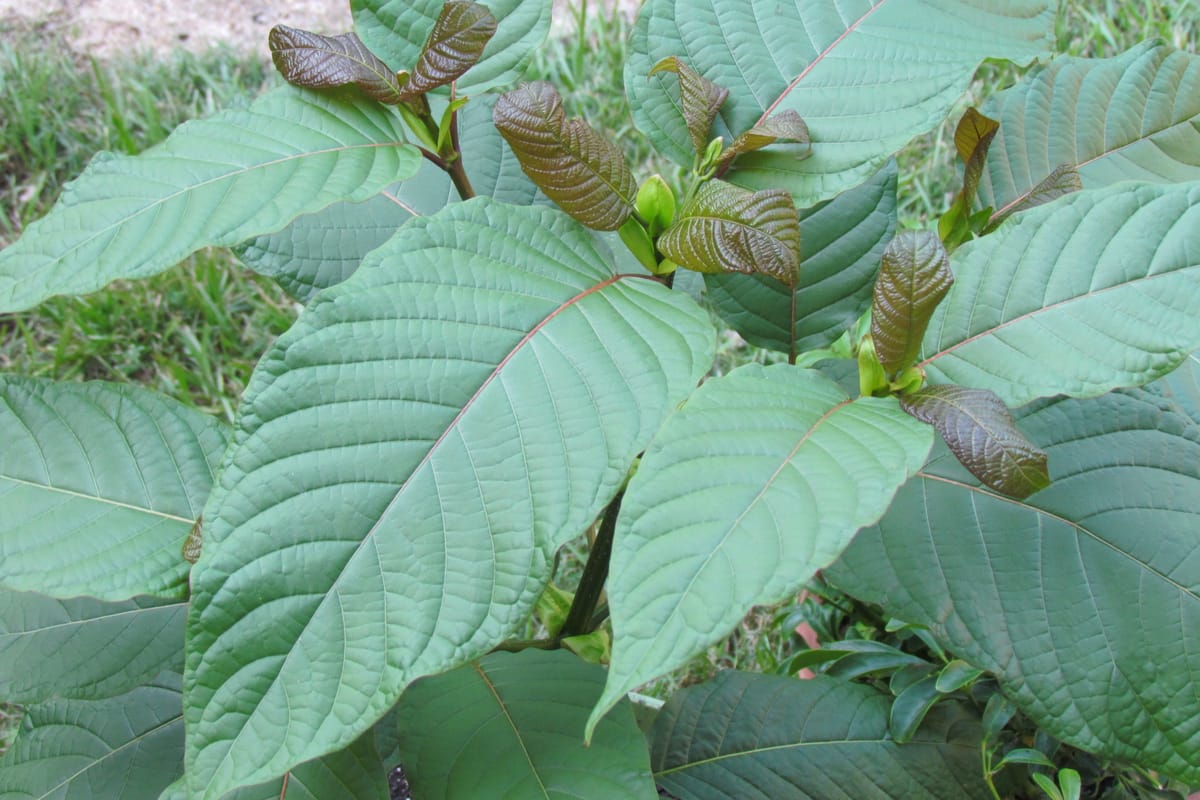
On the tree, kratom is big. A mature Mitragyna speciosa can reach about 25 meters (82 feet), with a straight trunk up to 0.9 meters across and smooth gray bark.1
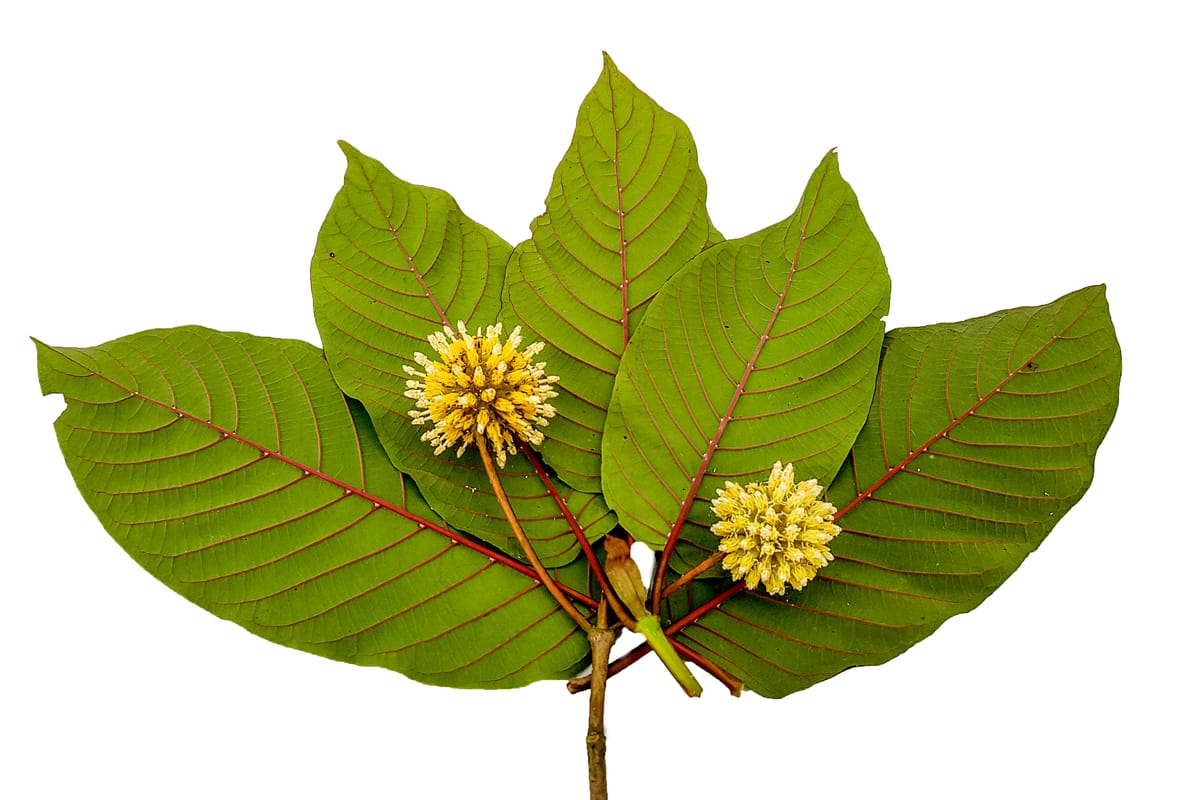
- Leaves: dark green and glossy on top, egg-shaped with a pointed tip, and arranged in opposite pairs along the stem. They can run longer than 14 to 20 cm and 7 to 12 cm wide.1
- Veins: each leaf has 12 to 17 pairs of side veins coming off the central midrib.1 On some trees the midrib and veins are reddish, on others green. A Thai survey of 611 leaf samples logged both red-veined and green-veined leaves, plus some with a serrated tip.5
- Flowers: deep yellow, spherical heads that grow in clusters of three at the ends of branches.1
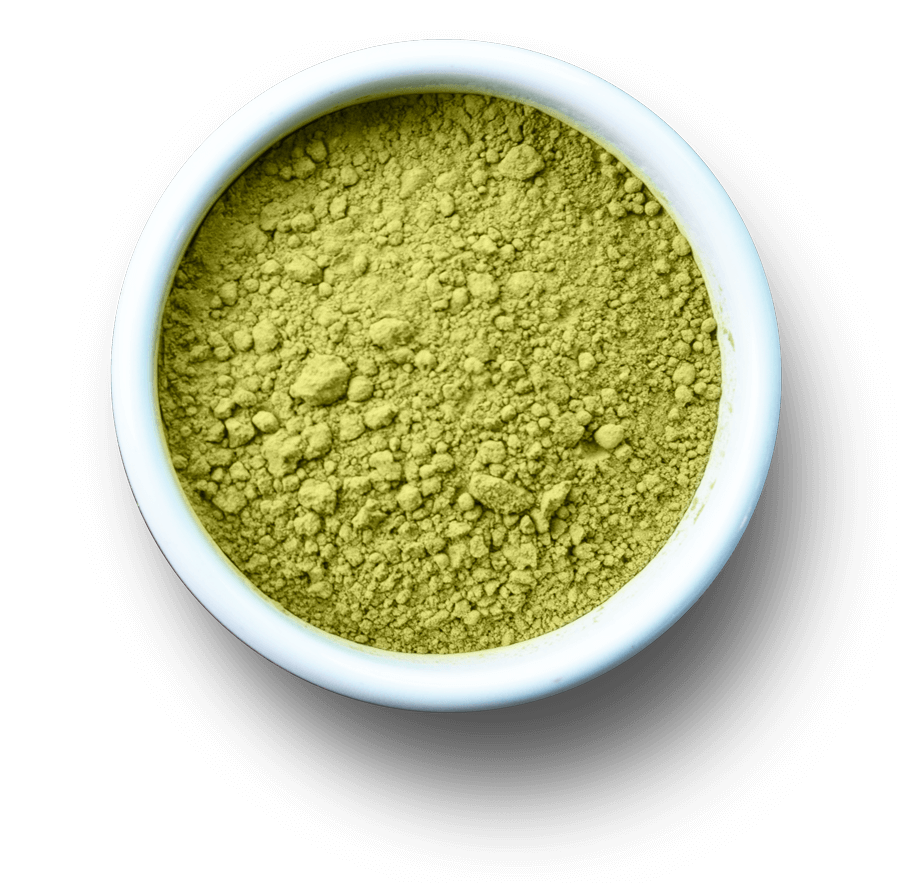
Once it reaches a store shelf, kratom looks very different. It is a fine, pale-to-olive green powder that looks a lot like matcha, or a coarser crushed leaf. The color of the powder is mostly green no matter what vein color is on the label; we explain where those red, green and white labels come from in our guide to kratom strain names.
What is kratom made of?
Chemically, the leaf is notable for its alkaloids. Kratom contains at least 54 of them, and at least 40 other compounds have been isolated from the leaves.1 The two that come up in every regulatory and lab discussion are:
- Mitragynine, the primary alkaloid by quantity.1
- 7-hydroxymitragynine (7-OH), a minor alkaloid that the FDA puts at under 2% of the leaf's total alkaloid content.3
How much mitragynine a leaf holds is not fixed. A study of 19 wild trees across four regions of Thailand measured mitragynine from 7.5 to 26.6 mg per gram of dry leaf, and tied the differences mainly to growing conditions: light intensity, humidity, soil moisture, soil pH and calcium.6 That spread is one reason a lab result tells you more about a given lot than the product name does.
A short history in Thailand, Malaysia and Indonesia
Kratom has a long record in the countries where it grows, and its legal history there swings hard in both directions.
Thailand. The leaf was part of village life: it was offered to guests and appeared in the ritual worship of ancestors and gods.1 The Kratom Act of 1943 made planting the tree illegal, and in 1979 kratom was placed in Category V of Thailand's narcotics law. Thailand began loosening that in 2018 and fully removed kratom from Category V in 2021, and more than 12,000 people convicted of kratom offenses received amnesty.1
Malaysia. Known locally as ketum or biak, kratom grows natively there, particularly in the north and on the east coast. Malaysian law prohibits using, importing, exporting, making, selling or possessing it.1
Indonesia. Indonesia is now the main producer for the export trade.1 In 2024 it recognized kratom as a legal export commodity, and in 2023 it shipped around 4,703 tons to the US, its largest buyer.4
From tree to US shelf
Most kratom sold in the US starts on smallholder farms in Indonesia. Research by the Indonesian legal aid group LBH Masyarakat among the Dayak Kalis community in Kapuas Hulu, West Kalimantan, found that around 80% of residents in Kalis Raya Village rely on growing and trading kratom as their main income. The tree grows there without fertilizer or intensive care, farmers can harvest leaves on a regular cycle, and the leaf moves to buyers through local traders.4
After picking, the leaves are dried, stripped of stems, and milled to powder. Our own suppliers describe that sequence plainly: hand-harvested leaves, de-stemmed, dried, and milled. Drying method varies by grower, and it is one of the things a vendor's product names try to describe.
That same LBH Masyarakat research recommends better post-harvest handling and fair market access for small farmers,4 which is a polite way of saying quality at the source is uneven. It is why testing in the US matters.
The forms kratom is sold in
All of these are the same leaf in different packaging or concentration:
- Powder. Milled dried leaf sold by weight. This is most of the market and most of our kratom catalog, from Red Bali to Green Maeng Da.
- Capsules. The same milled leaf, pre-filled into capsules. See kratom capsules on the hub.
- Extracts. Concentrated preparations of the leaf's alkaloids, such as our Black Reserve and Gold Reserve. These are a different regulatory conversation from plain leaf; more on that below.
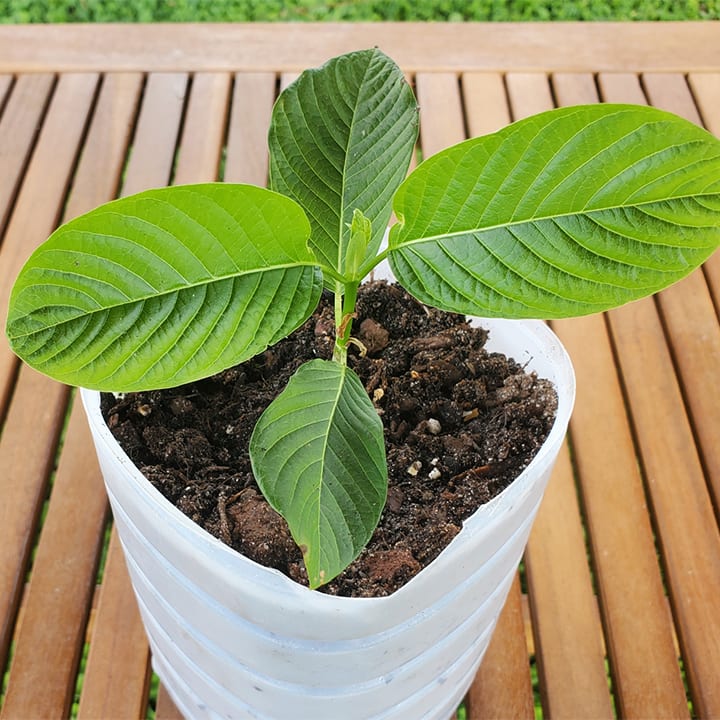
- Live plants. A small number of shops, ours included, sell young kratom trees for growers and collectors.
What is kratom classified as?
Federally, kratom is not on the controlled substances schedule. The DEA lists it as a "drug of concern," and it is legal and available online and in stores in many parts of the US.2 The FDA has not approved it for any medical purpose, says there are no prescription or over-the-counter drug products containing kratom or its alkaloids, and treats it as a new dietary ingredient without adequate safety information, which means it does not consider kratom acceptable as a dietary supplement.3
State and city law is where the real variation is. Several states and a number of cities ban it outright, and the list keeps changing; our state and city legality guide tracks it. Concentrated 7-OH products are also under separate federal scrutiny, which we cover in what the DEA has and hasn't scheduled for 7-OH. We do not ship kratom to restricted states; the current list is on our shipping restrictions page.
How to judge a kratom vendor
The FDA has warned about kratom products contaminated with Salmonella and with heavy metals,3 and NCCIH notes that heavy metals and disease-causing bacteria have been found in some kratom products.2 So the questions worth asking any seller are about testing and labeling, not marketing:
- Will they show you a Certificate of Analysis? A COA from a third-party lab should cover heavy metals, microbial contaminants, and alkaloid content. Ours come from ISO/IEC 17025 accredited labs, and you can ask for one through our COA request page.
- Does the label say what is inside? Look for the botanical name, the net weight, the format, and a lot or batch number you can match to a COA.
- Do they make health claims? They shouldn't. The FDA has not approved kratom for any medical use,3 so a seller promising outcomes is telling you something about how they operate.
- Do they check your state before shipping? A careful vendor blocks orders to places where kratom is banned and asks you to confirm you are 21 or older.
The short version
Kratom is the dried, usually powdered leaf of Mitragyna speciosa, a coffee-family tree from Southeast Asia that can grow to 25 meters. Its leaf contains dozens of alkaloids, led by mitragynine, in amounts that vary from tree to tree. Most of the US supply is grown by smallholders in Indonesia. It is federally unscheduled, regulated state by state, and only as good as the testing behind it. Browse our lab-tested kratom, shipped from Portland within 24 hours.
Sources
- "Mitragyna speciosa" (description, taxonomy, native range, alkaloids, history and legal status in Thailand, Malaysia and Indonesia). Wikipedia. en.wikipedia.org/wiki/Mitragyna_speciosa
- "Kratom." National Center for Complementary and Integrative Health (NIH). nccih.nih.gov/health/kratom
- "FDA and Kratom." U.S. Food and Drug Administration, content current as of December 2, 2025. fda.gov/news-events/public-health-focus/fda-and-kratom
- Humaida A, Nabila R. "Kratom Is Our Lifeblood: When Drug Policies Ignore Indigenous Livelihoods." TalkingDrugs, April 10, 2026 (LBH Masyarakat research in Kapuas Hulu, West Kalimantan). talkingdrugs.org
- Sengnon N, et al. "Seasonal and Geographic Variation in Alkaloid Content of Kratom (Mitragyna speciosa (Korth.) Havil.) from Thailand." Plants (Basel), 2023;12(4):949. pmc.ncbi.nlm.nih.gov/articles/PMC9966779
- Leksungnoen N, et al. "Variations in mitragynine content in the naturally growing Kratom (Mitragyna speciosa) population of Thailand." Frontiers in Plant Science, 2022;13. frontiersin.org
Header photo: "Kratom leaves 3" by ThorPorre, licensed CC BY 3.0. Source.