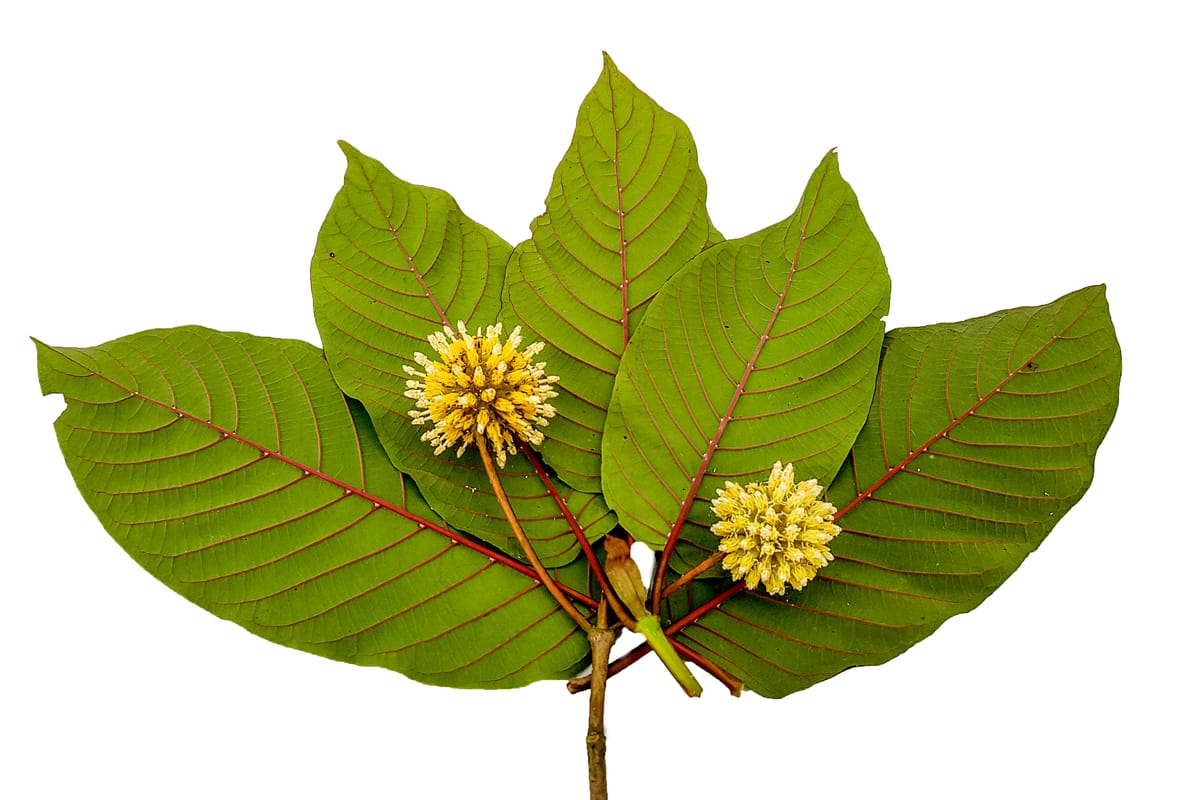
Every kratom product on the US market, ours included, comes from one species: Mitragyna speciosa.1 There are no botanically recognized kratom "strains" the way there are named apple cultivars. What the industry calls a strain is a trade name, and most of them are built from the same three parts:
| Part of the name | Example | What it points to |
|---|---|---|
| Vein color | Red, Green, White | The color of the leaf's midrib, and the harvest and drying style a vendor associates with it |
| Place name | Bali, Borneo, Sumatra, Thai, Malay | A region, port or lineage tied to the leaf, with varying accuracy |
| Trade name | Maeng Da, Hulu | A grade, lineage or local name used as a brand |
So "Green Maeng Da" is a vein-color word plus a trade name, and "Red Bali" is a vein-color word plus a place. None of these terms is defined by a regulator. This post takes each part in turn, then shows how to read a label and how we name our own products. It covers naming and sourcing only. We don't attach effects to any name, and you should be skeptical of anyone who does.
Part 1: Vein color
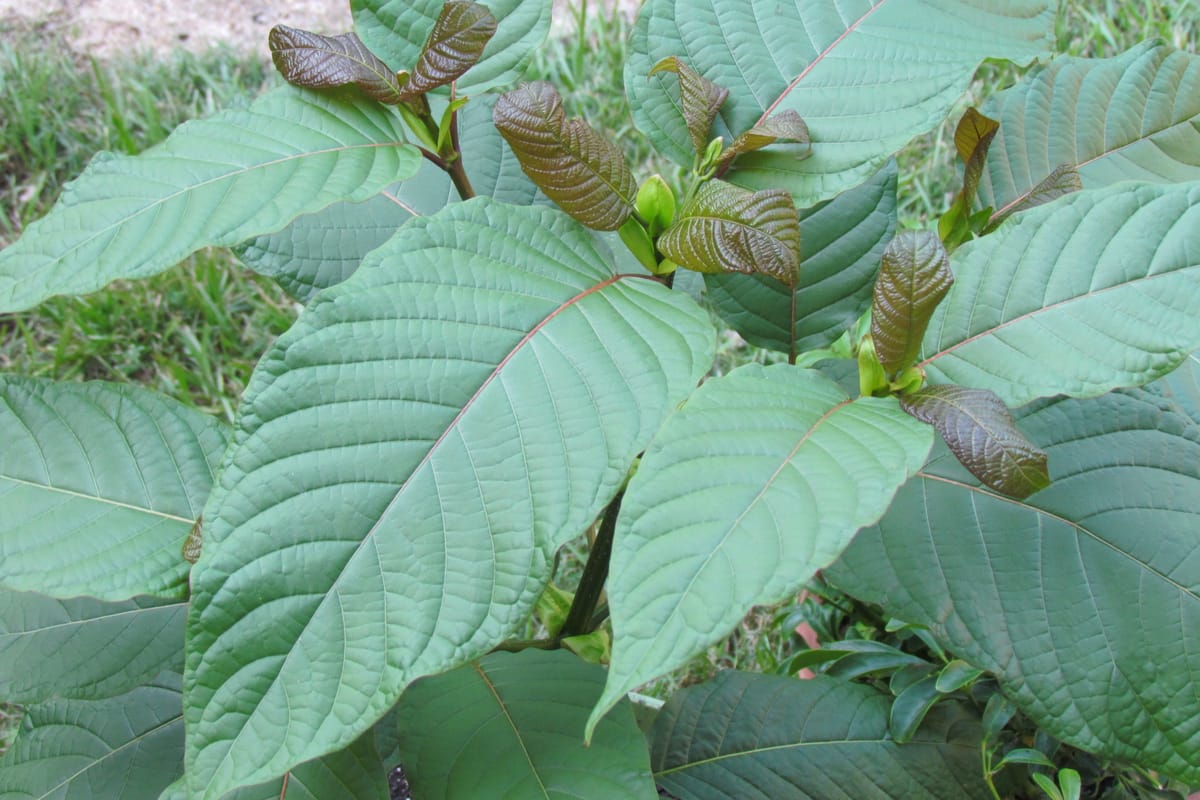
A kratom leaf has a central midrib with 12 to 17 pairs of side veins.2 On some leaves those veins are reddish; on others they're green. That's a real, visible trait. The best field data we found comes from a Thai study that collected 611 leaf samples from trees across the country and sorted them by vein type:1
- 57% green-veined
- 29% red-veined
- 5% red-veined with a serrated leaf tip
- 3% green-veined with a serrated leaf tip
- 6% unspecified
Two findings from that study matter for anyone reading a label. First, the researchers measured alkaloid production as "similar in both types of leaf, without significant differences." Second, they found "no genetic discriminant" between red- and green-veined leaves, and suggested vein color may come from the leaf's stage of development, possibly influenced by soil and nutrients, rather than from a distinct variety.1
Notice what is missing from that survey: white. White vein is a trade category. Vendors generally use it for leaf picked young and dried with less sun, green for mid-maturity leaf, and red for fully mature leaf, sometimes with longer drying or curing. Our own sourcing notes follow that convention, but the exact process differs from grower to grower and isn't standardized anywhere. In other words, the color on a bag describes a harvest-and-drying style the seller is claiming, and the powder inside will be green either way.
You'll also see yellow and gold. These are processing or blend names that vendors define for themselves, with no shared meaning across the market.
Part 2: Place names
Kratom is native to Thailand, Malaysia, Indonesia, Myanmar and Papua New Guinea, and is also found in Cambodia.2 The place names on labels mostly come from that map, but they don't all mean the same kind of thing:
- Bali. Usually a trade name rather than a farm location. We describe our Red Bali and Green Bali as named for the historic Port of Bali, a shipping hub for leaf grown across Indonesia.
- Borneo and Kalimantan. Indonesian Borneo is where much of the export crop is grown. Kapuas Hulu in West Kalimantan, for example, includes Kalis Raya Village, where about 80% of residents rely on kratom farming and trade.3 "Hulu" names usually point here.
- Sumatra. An Indonesian island and a common origin label.
- Thai. Kratom's natural range in Thailand is concentrated in the south.1 Thailand removed kratom from its narcotics schedule only in 2021,2 and on US labels "Thai" often refers to lineage rather than where the leaf was grown.
- Malay. Named for Malaysia. Keep in mind that Malaysian law prohibits exporting kratom,2 so a "Malay" label is best read as a style or lineage name. Ask the vendor where the lot was actually grown.
Indonesia is the main producer for the export trade, and the country formally recognized kratom as a legal export commodity in 2024.23 In 2023 it shipped around 4,703 tons to the US.3 Whatever place is printed on the bag, there's a good chance the leaf came through Indonesia.
Part 3: Trade names like Maeng Da
Maeng Da is the most recognized kratom name in the US, and it isn't a botanical variety. You won't find it in the plant's taxonomy, which recognizes one species, described by Korthals in 1839 and classified by Haviland in 1859.2 The name is Thai. It's usually glossed in vendor copy as slang for "pimp grade," meaning top-grade leaf, though we couldn't find a linguistic or botanical reference that confirms the translation, so treat it as trade lore.
In practice, Maeng Da is a grade and lineage name: Thai-origin stock that is now mostly grown in Indonesia. It is sold in all three vein colors, which is why you'll see White Maeng Da, Green Maeng Da and Red Maeng Da side by side. Two vendors' Maeng Da can come from different farms and different lots. The name tells you how the seller positions the product, not what's in it.
"Hulu," as in Green Hulu, works the same way: a regional name (the Hulu Kapuas area of Borneo) that has become a brand.
Names are marketing conventions, not regulated categories
No US agency defines what "red vein," "Bali" or "Maeng Da" must mean. The FDA does not recognize kratom as a lawful dietary supplement ingredient and has approved no drug products containing it,4 so there is no federal standard of identity for any kratom name. Nobody checks whether the word on the bag matches the farm, the harvest timing or the drying method.
Alkaloid content also varies for reasons a name can't capture. The Thai study above tracked mitragynine shifting by season and region,1 so two lots sold under the same name can test differently. The test result for the lot tells you more than the name does.
How to read a kratom label
Skip the name for a second and look for these:
- Botanical name. Mitragyna speciosa should be on it. If the product is an extract or blend, it should say so.
- Format and net weight. Powder, capsules or extract, and how much.
- Lot or batch number. This is what lets you match the bag to a lab report.
- A Certificate of Analysis. The FDA has warned about kratom products contaminated with Salmonella and heavy metals,4 and NCCIH reports heavy metals and disease-causing bacteria in some products.5 A third-party COA should cover heavy metals, microbials and mitragynine content. Ours are available through our COA request page.
- No health claims. If a label or product page says a color or strain will do something for you, that's a claim the FDA hasn't accepted for kratom.4 We'd move on.
- Age and state notices. A 21+ notice and a list of places the seller won't ship. Ours is on the shipping restrictions page, and the background is in our state and city legality guide.
How Herb Stomp names its kratom
We use the common trade names because that's what people search for, and we try to say plainly what each name means for our lot:
| Product | What the name means for us |
|---|---|
| Red Vein, Green Vein, White Vein | Vein color only. Our general Southeast Asian lots, labeled by leaf maturity at harvest and drying style. |
| Red Bali, Green Bali | Named for the Port of Bali trade route; leaf grown in Indonesia. |
| Red Sumatra | Sourced from Sumatra, Indonesia. |
| Green Hulu | From the Hulu Kapuas region of Borneo, Indonesia. |
| Green, Red and White Maeng Da | Thai-origin lineage from established Indonesian growers. |
| Green Malay, Red Malay | Malay-style names; ask us about the lot's growing region. |
Every one of them is the same species, third-party tested by ISO/IEC 17025 accredited labs. You can browse them all, filtered by vein color, on our kratom page.
Sources
- Sengnon N, et al. "Seasonal and Geographic Variation in Alkaloid Content of Kratom (Mitragyna speciosa (Korth.) Havil.) from Thailand." Plants (Basel), 2023;12(4):949. pmc.ncbi.nlm.nih.gov/articles/PMC9966779
- "Mitragyna speciosa" (description, taxonomy, native range, legal status in Thailand, Malaysia and Indonesia). Wikipedia. en.wikipedia.org/wiki/Mitragyna_speciosa
- Humaida A, Nabila R. "Kratom Is Our Lifeblood: When Drug Policies Ignore Indigenous Livelihoods." TalkingDrugs, April 10, 2026 (LBH Masyarakat research in Kapuas Hulu, West Kalimantan). talkingdrugs.org
- "FDA and Kratom." U.S. Food and Drug Administration, content current as of December 2, 2025. fda.gov/news-events/public-health-focus/fda-and-kratom
- "Kratom." National Center for Complementary and Integrative Health (NIH). nccih.nih.gov/health/kratom
Header photo: "Kratom leaves" by Thehealingeast, licensed CC BY-SA 4.0. Source.